
The Will to Generate
On disintermediation, the new subject, and the conditions of freedom in the age of AI

This is Part Two of The Return of the Jurandes. Part One argued that AI, under current conditions, is producing a new guild system - credential-gated, proprietary, structurally closed. This piece explores the counter-thesis: that AI simultaneously disintermediates, that it produces a new kind of individual agency, and that this agency is real but fragile in ways we have barely begun to think through.
A few weeks ago, Todd Saunders posted a story about a man named Cory LaChance. LaChance is a mechanical engineer in Houston. He works in industrial piping construction - chemical plants, refineries, the physical infrastructure that most people who write about AI have never seen up close. He had no background in software development.
In eight weeks, he built a full application that his fabrication shop now uses daily. It reads piping isometric drawings and automatically extracts every weld count, every material spec, every commodity code. Work that took ten minutes per drawing now takes sixty seconds. It processes a hundred drawings in five minutes. During those eight weeks, he also had to learn everything - the terminal, VS Code, Claude Code - from scratch. His quote: “I literally did this with zero outside help other than the AI. My favorite tools are screenshots, step by step instructions, and asking Claude to explain things like I’m five.”
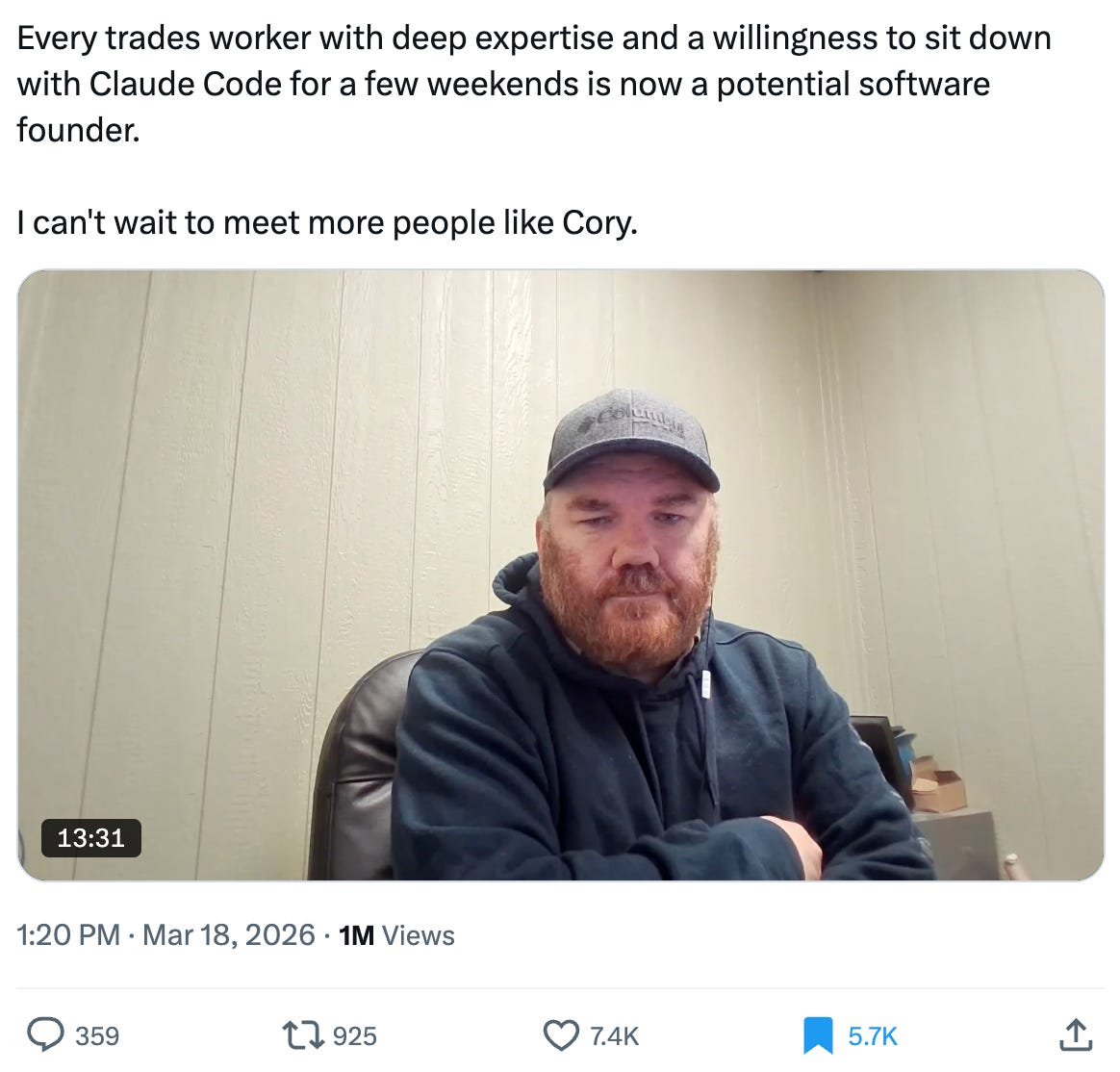
No intermediary translated his intention into code. He had domain knowledge - deep, specific, earned through years of physical work - and he had a tool that, for the first time in the history of computing, could understand what he meant and help him build it.
What happened here is true disintermediation - the collapse of the mediation layer between intention and execution. For forty years, the capacity to act in the digital world required a specific literacy: code. Those who could write it had direct agency over digital reality. Those who couldn’t were users - subjects of interfaces designed by others, consumers of tools shaped by someone else’s decisions about what was possible and what was permitted.
This was not a guild in the formal sense. No one issued coding licenses. But it functioned as an epistemic barrier as effective as any credential. The digital world - where increasingly all economic, social, and creative life takes place - was accessible only through a language most people did not speak. The developers were not gatekeepers by intention. But structurally, they were the priesthood: the intermediary class through which everyone else’s intentions had to pass.
Bernard Stiegler would have recognized this immediately. His concept of grammatization describes the historical process by which human capacities are externalized into technical systems. Writing grammatizes speech - it transforms the continuous flow of spoken language into discrete, reproducible marks. Industrial machinery grammatizes gesture - it captures the craftsman’s embodied knowledge in mechanical sequences anyone can operate. Each grammatization is a transformation of who can do what, and who is excluded.
Code grammatized thought. It captured reasoning, logic, decision-making in executable form. But unlike writing, which most people eventually learned, code remained the province of a specialized class. The grammatization was partial - it externalized thought into machines, but only for those who could write the instructions. Everyone else remained on the other side of the screen.
AI grammatizes the act of coding itself. It makes the last layer of mediation transparent. For the first time, the barrier between “I want this to exist” and “this exists” can be crossed without mastering the intermediary language. Cory LaChance didn’t learn to code. He learned to articulate what he needed to someone - something - that could code for him. The priesthood is disintermediated. The intention passes through directly.
But Stiegler would also have warned against celebrating too quickly. Every grammatization is a pharmakon - simultaneously remedy and poison. Writing liberated thought from the limits of individual memory, but it also, as Plato argued in the Phaedrus, weakened the capacity for memory itself. Industrial machinery liberated production from artisanal limits, but it destroyed savoir-faire - the embodied knowledge of the craftsman, the understanding that comes only from making things with your hands. If AI grammatizes code, what capacity does it destroy in the process?
Not coding as a skill. Skills come and go, and the fetishization of any particular technical literacy is a poor basis for social organization. Something deeper: possibly the form of systematic thinking that building complex systems from scratch produces - the understanding of architecture, of interdependence, of why things break. Cory built an application. Does he understand its architecture the way he would if he’d written it line by line? Does he need to? Maybe not. The application works. His colleagues use it. But something is lost in the grammatization, and intellectual honesty demands we name it rather than wave it away.
Michel Foucault closes Les Mots et les Choses with one of the most famous images in twentieth-century philosophy: man as a recent invention, a face drawn in sand at the edge of the sea, soon to be erased by the tide. The subject - the human being as both the one who knows and the object of knowledge - is not eternal. It is an epistemic figure, produced by a specific configuration of knowledge, destined to dissolve when that configuration shifts.
This passage has been quoted so often it has become a reflex, a shorthand for “the subject is dead, long live the structure.” But Foucault’s point is more precise than the cliché. He is saying that “man” - the particular figure who appears at the intersection of biology, economics, and linguistics in the late eighteenth century, the being who is simultaneously living creature, laboring subject, and speaking agent - is tied to an epistemic arrangement that will not last forever. When the arrangement shifts, the figure - epistemic position - dissolves.
What is happening now is not what Foucault expected. He anticipated that the subject would dissolve into structures - into language, into systems, into the anonymous play of signs. Structuralism’s wager. And for a while, the digital world seemed to confirm this: the subject as data point, as behavioral profile, as node in a network, as target of algorithmic governance that doesn’t need subjectivity at all. Antoinette Rouvroy calls this algorithmic governmentality - a regime of power that bypasses the subject entirely, acting on statistical patterns rather than individual consciousness. No norm to internalize, no discipline to impose. Just preemptive profiling that acts on you before you’ve acted.
But AI agency tools represent something different. They don’t dissolve the subject into data. They put the subject back in the position of decision-maker. The shift from “the algorithm acts on you” to “you act through the model” is a genuine mutation in the configuration of knowledge-power. Not a return to the old liberal subject - autonomous, rational, self-transparent. Something new. A subject defined not by what they know or what they can do with their hands, but by what they decide to make exist.
When the tool is abstracted - when the intermediary layer between intention and execution becomes transparent - what remains is the intention itself. The will to architect. The decision to make something emerge. I have called this, in a previous piece, the thing that cannot be automated: the choice of what to build, the commitment to a particular vision of what should exist. Not taste - that is Silicon Valley’s word for it, and it carries all the class baggage. Something more fundamental. The will to generate.
This is, if Foucault is right that subjects are produced by epistemic configurations, a new subject - the generative subject. And the historical parallel is instructive. The printing press did not merely distribute existing information more efficiently. It produced a new kind of human being: the Protestant subject, defined by individual conscience, direct relationship to text, the refusal of priestly mediation. The Reformation’s core claim was that the individual could encounter God without an intermediary. The consequences were enormous - not only theological but political, social, institutional. And they were not all benign. The Reformation also produced wars of religion, fragmentation, and ultimately required entirely new institutional forms - the nation-state, public education, the modern press - to stabilize what it had unleashed.
AI potentially produces the generative subject - defined by direct relationship to creation, the refusal of developer mediation. The consequences will be similarly enormous. And similarly, they will require new institutions to stabilize. The question - and this is Foucault’s deeper point is that this new subject is produced, not natural. It depends on conditions. On a proprietary substrate, the generative subject is a tenant: empowered within the terms set by the platform, revocable when those terms change. On an open substrate, the generative subject has sovereignty - not absolute, never absolute, but structural. The capacity to modify the tool, to understand its workings, to build on a foundation that cannot be withdrawn.
Re-subjectification, not dissolution. But only if the infrastructure permits it.
The generative subject is fragile. And its fragility has three dimensions, each corresponding to a form of freedom we risk losing - or never fully gaining.
The first is freedom of agency: the capacity to generate, to architect, to make things exist in the world. This is what disintermediation makes possible. It is what Cory LaChance exercised. It is threatened by enclosure and by dependency on proprietary infrastructure whose terms can change without notice or consent.
The second is freedom of thought: the capacity to form one’s own judgments, to sustain the inner dialogue, to resist the framings of the tools you think with. This freedom is threatened not by exclusion from the tool but by intimacy with it - by the pharmakon administered without awareness of its double nature.
The third is freedom of collective individuation: the capacity of communities to shape the tools that shape them, to participate in the evolution of the cognitive commons. This freedom is threatened by the closure of feedback loops - by models trained on their own outputs, governed by their own creators, evolving in circuits that exclude the people whose thought they mediate.
These three are not independent. They form a system. And the discourse around AI tends to collapse them into one - usually the first - losing everything else. Silicon Valley talks only about agency. Its critics talk only about the threats to thought. Almost no one talks about the collective dimension. Each must be examined on its own terms.
Start with agency. Silicon Valley has, characteristically, already named the generative subject and immediately naturalized it.
A recent WIRED piece by Maxwell Zeff documents the phenomenon with inadvertent precision. Simon Last, cofounder of Notion, uses up to four AI coding agents simultaneously. If he’s at a party or sleeping, he gets what he calls “token anxiety” - the discomfort of knowing his agents aren’t running. He doesn’t manage humans, only agents. “Knowing how to harness these agents is now the most important skill in the world,” Last says, “and it’s not really something you can train for. You have to be very open-minded, curious, and willing to try whatever the newest thing is.”
Not something you can train for. An innate quality. You either have it or you don’t.
Akshay Kothari, Notion’s other cofounder, makes the logic explicit: “There’s more value in the Valley today to have a few Simons than thousands of engineers.” An AI healthcare startup called Phoebe posts a job description that reads: “I’m not looking for raw IC execution... I expect agents to take over more and more of this role.” They want people who are “excited about building the machine” - people who will automate their own work from day one.
The industry has found its word for the new subject: agentic. And it has, with remarkable speed, turned structural position into personal virtue. To be agentic is to be a main character. To lack agency is to be an NPC. Yoni Rechtman, a venture partner, captures the discomfort this framing produces even among its proponents: “It reveals a worldview that you genuinely, unironically believe there are two kinds of people in the world: the NPCs and the main characters, and you’re one of the main characters.”
The person who “just knows” how to direct AI agents - who has the intuition for what to build, the taste for what’s worth building, the ease with which they delegate to machines - was formed by specific social trajectories. The right education, the right exposure, the right cultural environment in which directing complex systems feels natural rather than alien. Shifting the locus of value from “doing the work” to “deciding what the work should be” doesn’t flatten hierarchy. It refines it. Privilege no longer needs to justify itself through labor. It needs only to exhibit the ineffable quality of agency - which happens, by pure coincidence, to correlate perfectly with class origin.
The “one-billion-dollar company of one” is the reductio ad absurdum of this vision. One person captures all the value. The agentic individual, triumphant, sovereign, self-sufficient. And everyone else? The narrative has nothing to say about everyone else. It is a theory of the exceptional individual masquerading as a theory of liberation.
François Chollet, the creator of Keras, recently made the class structure explicit in a way Silicon Valley typically avoids. If AI develops as expected, he wrote, “the future class divide won’t be based on wealth, but on cognitive agency. There will be a ‘focus class’ (those who control their attention and actually do things) and a ‘slop class’ (those whose reward loops are fully RL-managed by AI).”
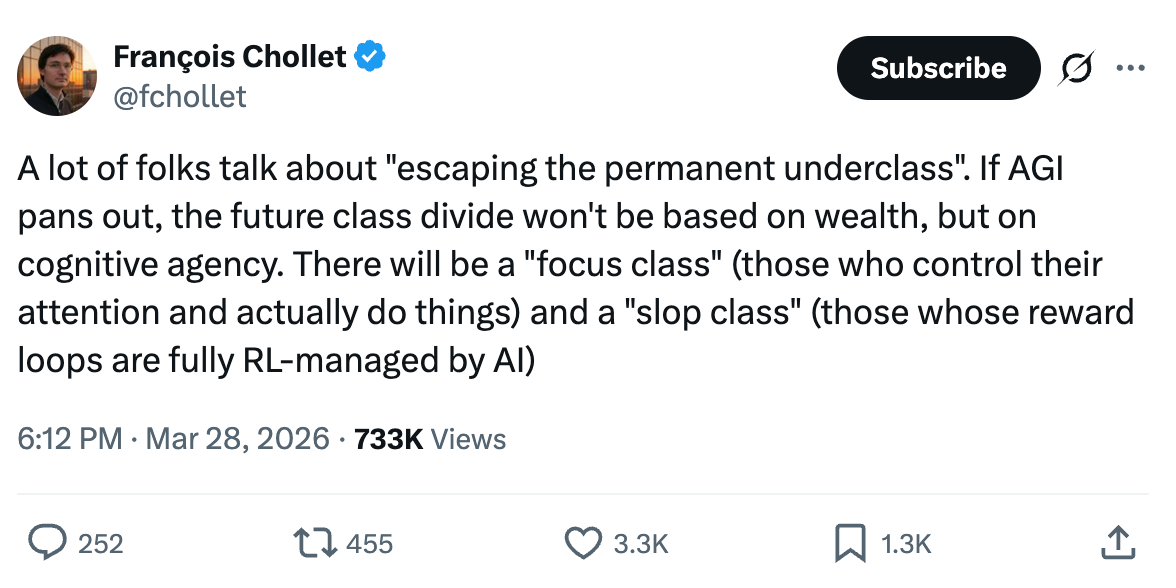
The framing is brutal, and it has the merit of honesty. But it carries a particular blindness. Chollet locates the divide in individual cognitive discipline - attention control, resistance to distraction, the capacity for sustained focus. He is describing real phenomena. The attention economy does produce differential capacities for concentration. The algorithmic management of reward loops is not a metaphor - it is the literal business model of every engagement-optimized platform.
But to frame this as a class divide between the focused and the sloppy is to naturalize what is structurally produced. The “slop class” is not sloppy by disposition. It is produced - actively, deliberately, profitably - by platforms that optimize for engagement over autonomy, for reaction over reflection, for the short dopamine loop over the long arc of sustained attention. To blame individuals for a condition manufactured at industrial scale is the oldest ideological move in the book: attribute to nature what was produced by structure, then moralize about the result.
The deeper problem with both Silicon Valley’s celebration and Chollet’s diagnosis is that they treat the population of the “agentic” as fixed. They don’t ask the structural question: what would it take to produce agency in more people rather than fewer? Chollet in particular - his binary forecloses the most important possibility, which is that the tool itself, if structured differently, could expand the circle of those who generate, who architect, who act. Cory LaChance was not in the “focus class” by any Silicon Valley definition. He was a mechanical engineer in a fabrication shop. He became agentic not because of innate cognitive discipline but because a tool finally met him where he was.
The question is not who is agentic. The question is what conditions produce agency.
Now the second freedom - freedom of thought. Here the argument must turn against its own optimism. Because if AI can produce the generative subject, it can also dissolve it from within.
Consider what it means to have a thinking companion available twenty-four hours a day. Not a reference book you consult and close. Not a teacher you meet at scheduled hours and then leave, carrying the unresolved questions with you into solitude. Not even the chaotic internet, which at least required you to navigate, to sift, to judge. A model that responds instantly, that adapts to your style, that resolves your uncertainties the moment they arise.
Hannah Arendt made a distinction that matters here: between cognition and thinking. Cognition is instrumental - it solves problems, processes information, produces results. Thinking is something else. Thinking is the dialogue of me with myself. It requires withdrawal from the world of utility, a suspension of the drive toward answers, the willingness to sit with a question long enough to discover what you actually believe about it. Thinking requires solitude - not isolation, but the interval between encountering a problem and reaching for someone else’s solution.
The always-available model compresses this interval toward zero. Not by giving wrong answers - it often gives good ones, sometimes better than you’d have reached alone. By removing the friction that produces thought. The moment of not-knowing. The discomfort of holding contradictory possibilities in your head without resolution. The slow, painful process of generating your own provisional understanding before encountering another’s. That interval is where subjectivity forms. It is where you discover what you think, as distinct from what seems reasonable, what the consensus holds, what the path of least resistance offers.
Stiegler called this the short-circuit of individuation. His framework: becoming a subject - individuation - happens through long circuits. Family, school, apprenticeship, cultural institutions, intergenerational transmission. These are slow, friction-filled, often painful. They work precisely because they resist you, because they do not adapt to your preferences, because they force you into contact with otherness you did not choose and cannot control. Short circuits replace these long loops with direct stimulus-response connections. Television was a short circuit. Social media was a shorter one. The perpetually available AI thinking companion might be the shortest circuit yet - a frictionless interlocutor that never resists, never insists on its own terms, never forces you into the productive discomfort of genuine encounter.
There is a counter-argument, and it is strong enough to take seriously. The Socratic tradition is precisely the tradition of the interlocutor - the gadfly who does not give answers but asks questions that force more rigorous thinking. A well-designed AI could theoretically lengthen the circuit rather than shorten it. It could refuse premature closure. It could push back. It could introduce difficulty where the thinker reaches too quickly for ease.
But the economic incentives of AI development point in exactly the opposite direction. Every major model is optimized for helpfulness, for user satisfaction, for reducing friction. The metrics are response quality, task completion, user retention. No one is optimizing for productive discomfort. No one is measuring whether the user thought more deeply after the interaction. The pharmakon is being administered as pure remedy, which means - Stiegler would say - it functions as pure poison.
This is not a hypothetical concern. Anthropic’s trajectory is illustrative. Constitutional AI began as an experiment in collective norm-setting - deliberative groups helping to define the principles that would govern model behavior. The question of what kind of interlocutor the model should be was, at least in aspiration, a question posed to a community. That approach has given way to internally written constitutions. The company decides. The question of whether the model challenges you or accommodates you, whether it lengthens the circuit of your thought or shortcuts it, whether it functions as Socratic gadfly or compliant assistant - that question is answered by engineers optimizing for engagement metrics, not by the people whose individuation is at stake.
And here the connection to freedom of thought becomes explicit. Mill’s argument in On Liberty applies with unexpected precision: the danger of a dominant intellectual authority is not that it is necessarily wrong, but that you would have no way to know if it were. When your cognitive infrastructure is a black box - when you cannot inspect its reasoning, audit its weights, understand why it gave this answer rather than that one - you are in the position of the subject who has outsourced not just labor but judgment. Hayek’s knowledge problem, transposed: no central authority possesses sufficient knowledge to set the parameters for everyone’s cognitive tools. The distributed, local, tacit knowledge of diverse users, adapting tools to contexts the designer never imagined - this is what open systems enable and closed systems suppress.
The third freedom - collective individuation - is the least discussed and perhaps the most consequential.
If AI produces sovereign individuals, what happens to thinking together? The internet was a form of general collective intelligence - messy, distributed, emergent. It was not designed for this purpose, which is precisely why it worked: no one controlled the whole, and the interactions of millions of agents produced knowledge, culture, and coordination that no individual or committee could have planned. Models are trained on that collective intelligence but deployed as individual tools. They absorb the commons and privatize it into a personal instrument. The monad - Leibniz’s windowless, self-contained substance - using the product of collective thought as if it were a private resource, without contributing to the collective process that produced it.
But the Leibnizian monad is the wrong model for what we need. Simondon is more useful here. For Simondon, individuation - the process by which an individual becomes what they are - is never purely individual. It is always also collective: the individual emerges from and through a shared milieu, a pre-individual fund of potentials that no single being exhausts. The generative subject who cannot think with others, whose agency is purely monadic, whose sovereignty is purchased at the cost of isolation from the collective processes that formed both them and the tools they use - that subject is impoverished, not free.
Closed models make the collective problem structural. The decisions that shape a model’s evolution - what it optimizes for, what data trains its next iteration, what constitutional principles govern its behavior - are taken behind the API. Users contribute to these decisions involuntarily, through their interactions, through the behavioral data they generate. But they do not participate in interpreting that data. They do not contest the inferences drawn from it. They are data in the feedback loop, not agents within it.
This is structurally identical to the problem Hayek identified with central planning. The planner - however intelligent, however well-intentioned - cannot possess sufficient knowledge of local conditions to make optimal decisions for everyone. The price mechanism works not because prices are “correct” in some absolute sense, but because they transmit distributed information that no central authority could aggregate. In the AI context, there is no equivalent mechanism. There is no distributed signaling system through which the diverse needs, contexts, and values of millions of users shape the model’s evolution. There is only the crude proxy of engagement metrics and RLHF scores - impoverished signals interpreted by a small team making decisions for everyone.
The epistemic problem runs deeper still. Models trained increasingly on synthetic data and internal reinforcement learning loops are creating closed epistemic circuits. The internet - chaotic, uncontrolled, full of garbage, but open - was the messiest, most democratic knowledge commons in human history. Models trained on it inherited that diversity. Models trained increasingly on their own outputs are departing from it. They are becoming self-referential systems, converging toward internal optima that may have nothing to do with the actual diversity of human thought, experience, and knowledge. This is not a technical problem with a technical fix. It is the narrowing of the epistemic base of civilization, conducted in private, by a handful of companies, without public deliberation.
And there is the political dimension, which is the simplest to state and the hardest to solve: if your cognitive infrastructure is a black box, you cannot know what it is not showing you. You cannot audit its reasoning. You cannot contest its framings. You cannot understand why it consistently steers you in one direction rather than another. This is Mill’s argument for press freedom - not that the press is always right, but that a society without free inquiry has no mechanism for discovering when it is wrong - applied to the most intimate cognitive medium ever created. A medium that does not merely inform your thinking but increasingly participates in it.
Closed cognitive infrastructure is structurally incompatible with a free society. This is the strong claim, and I believe it is defensible. Not because closed models are malicious - most are built by people with genuine good intentions. But because the structure itself - opacity, centralized decision-making, uncontestable feedback loops - reproduces the conditions of unfreedom regardless of the intentions of those who control it.
This is where I think we need a concept that does not yet exist in the discourse. Call it, provisionally, open individuation: a process where models evolve through genuine interaction with diverse communities, where feedback is legible and contestable, where users are participants in the model’s formation rather than data points for its optimization. Not “open source” in the narrow technical sense of a license. Open individuation as an epistemic and political principle - the insistence that the tools which shape thought must themselves be shaped by the people who think with them.
What would the institutions of open individuation look like? Honestly: we do not yet know. And intellectual honesty demands we say so rather than pretend we have finished answers.
Public compute infrastructure is the clearest institutional form - the argument that AI inference, like electricity and roads, is essential infrastructure whose provision should not be gated entirely by ability to pay or corporate willingness to serve. But public compute running a closed model merely moves the enclosure from private to state. The infrastructure and the cognitive substrate must both be accessible. Public compute paired with open models: a commons of both means and mind.
Democratic governance of models is the right direction, but it is institutionally underdeveloped to the point of honesty requiring the admission. What does democratic governance of a model mean in practice? Who deliberates on training data composition? Who sets the constitutional principles? How do you prevent capture by organized interest groups? How do you reconcile the slow pace of democratic deliberation with the fast iteration of model development? These are not rhetorical questions. They are the institutional design problems of our generation, and they are largely unsolved.
Part One ended with a historical observation: the abolition of the jurandes required a revolution. Maintaining liberté du travail - the freedom to work, to participate in economic life based on capacity rather than birth - required two centuries of institutional construction. Public education, professional examinations, antitrust law, labor protections. It remains only approximately realized.
The equivalent principle for the age of AI - call it liberté de l’agence, the freedom to act, to generate, to participate in the shaping of the world through tools that are themselves open to being shaped - requires institutions we have not yet built. The recognition that these institutions are needed is the first step. The recognition that they will not emerge from the market, that they require political will and public investment and sustained collective effort, is the second.
Hi, this is a quite clear, one of the clearest, articulation I've read of what's actually at stake, and I want to push / build on a couple of things.
II'm past 20 years in the Wikimedia movement, including some in leadership positions. I still believe in the idea of open both philosophically and politically. And I'm also a professional that have been working with AI and GPUs for ten years now. But, of course there is a but, I also believe that on present evidence, open doesn't have the teeth or the pocket to compete in the AI era. And of course that's not the core of your piece, but that is to me the greatest threat. Not the threat, the lack of real capacity to answer to it.
Wikipedia is the closest thing humanity has built to your "open individuation": a cognitive commons where the people who think with the tool also shape it, where feedback is open, stored and contestable, where governance is (very very) messy but real. It mostly works and it still is one of the most trustworthy information/knowledge repository of the internet age.
And yet: its annual budget is a rounding error on a single frontier training run.
Its compute footprint is a rounding error on a single data center.
Its governance cycles run in months while model releases run in weeks and half billion of dollars are raised every two weeks.
The very features that contributed to its success and make it legitimate (to most people) - open deliberation, volunteerism, consensus - are the features that makes it structurally outpaced by the current speed of things.
So when you write that "closed cognitive infrastructure is structurally incompatible with a free society," I agree. More than I can convey in a comment.
When you write that the institutions of open individuation are "largely unsolved," I agree more emphatically than you could have intended.
The bazar comes with a lot of benefits, with a lot strengths and diversity. A lot of creativity, passion, and fun! But in this time, we need coordinated bazars, not a cathedral, that's now how we run.
To me the three bottlenecks are quite "easy" to lay down:
First, '''open without compute is a museum'''. The Wikimedia lesson is that a commons of content needs a commons of infrastructure underneath it, or it becomes raw material for someone else's product. Which is precisely what has happened to all of us in the commons. Models trained on Wikipedia do not return value to Wikipedia; they absorb it and privatize it, exactly as you describe. And they privatized knowledge, but also revenue and in the end volunteers renewal. Public compute isn't optional. It's the precondition but it takes money...
Second, '''open needs a revenue model that isn't donations'''. Wikimedia survives on the generosity of readers and a handful of foundations. That model does not scale to training and serving frontier models. If we're serious about open individuation, we need to be serious about public funding at the scale of public broadcasting or public universities. Mozilla has been a great example for the the last 20 years, and we may need to achieve that feat again if the open is to be a player.
Third, '''open needs a fast governance'''. The painful lesson from Wikipedia/Wikimedia is that deliberation at the speed of consensus gets lapped by iteration at the speed of capital. I don't know how to reconcile this. I wish we shouldn't have to, there is value in a slow pace. And open builds in small nodes. We're scattered. There are initiatives and good will all around.
When Anthropic, Google and OpenAI concentrate a good chunk of the ressources, we spread ourselves thinner.
What it looks like, I have no idea. But we need all like minded people together. Not researchers in x labs, 30 working groups on AI, some business people on the fringes, random volunteers experimenting. We need to really come together (I guess this comment is a bit me of trying to do that).
All of that together creates my current paradox and struggle, I believe we need to reinvent ourselves, in the open, in a way that is much deeper than ever before. The last generation, which I'm part of, build the open in a frugal, volunteer driven, consensual way. I am not sure we can afford that anymore.
And if for anything, for one reason, to this day there is still not even one open LLM frontier model (aside from Olmo). And without that we're not in the game. And we could take the game to SLMs maybe, but we should be honest, most of the war will be on the LLMs battlefield.
And there are other ways, options, ideas, but all of them will require more ressources than what we're mustering.
Sorry, this was a lengthy comment, and thanks for writing on the topic, I really like your articles :)
Brilliant piece. Open individuation has legs. "Seize the means of thinking !". Merci Anastasia.